Blog · How we work
Why does every client matter have its own lane?
Halden Foods is matter 2041. Orrin Marine is matter 2057. Their working papers are never in the same place, even though some of the same people work on both. Harriet Larkspur on what a matter lane is and what it protects.
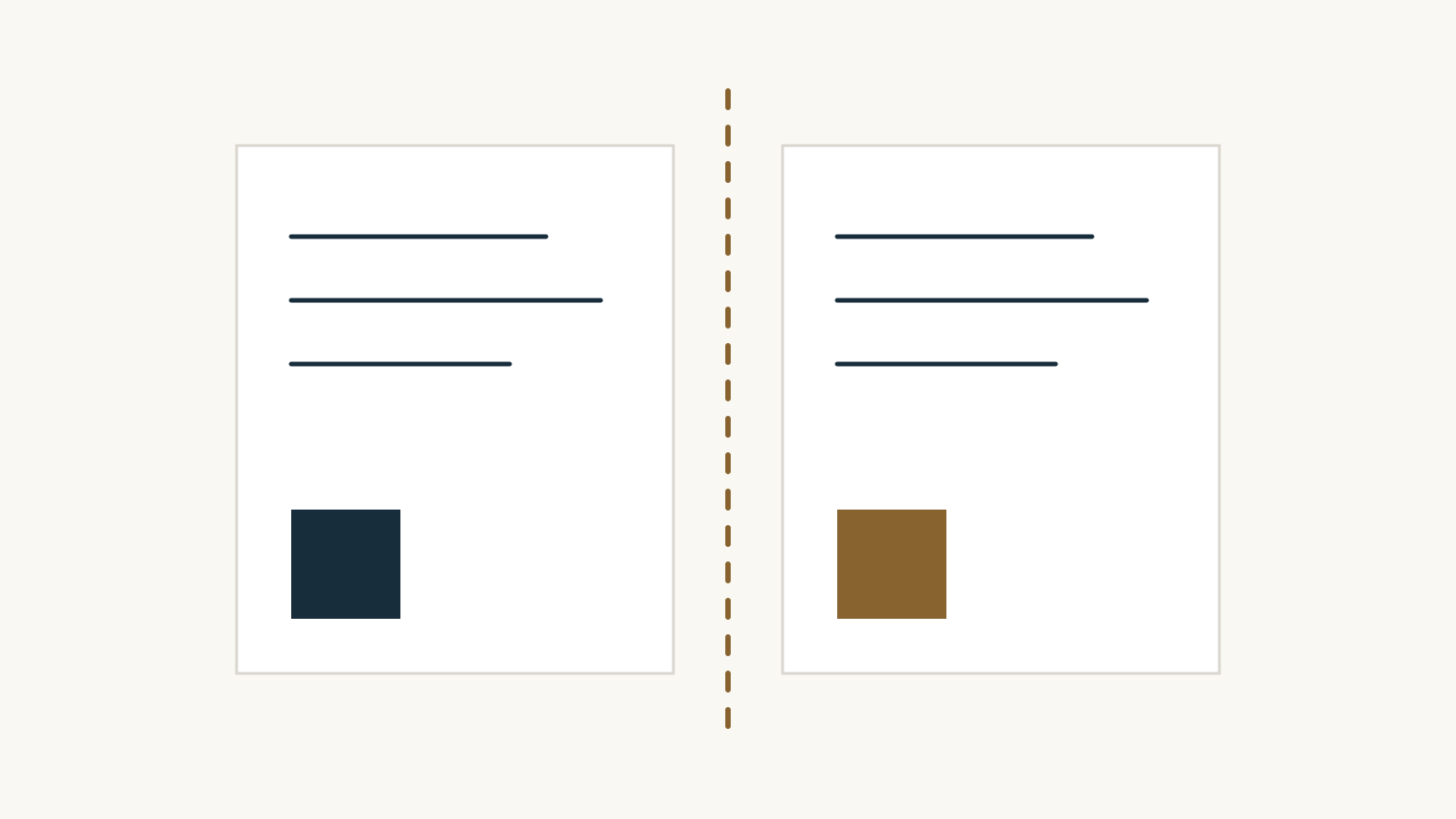
Every client matter has its own lane because a client's working papers belong to that client's matter team and to nobody else. At Larkspur & Vance a lane is the matter's restricted set of documents, the team who may read them, and the record of who did. Halden Foods is matter 2041 and Orrin Marine is matter 2057. The firm's shared methods are visible to everyone; a client's equipment schedule or controls evidence is visible only inside its lane. A person who works on both matters does not carry facts between them.
Harriet Larkspur · Managing Partner · · 4 min read
Last updated
What is a matter lane?
Three things together. The matter's restricted documents: for Halden, the equipment schedule review and the research behind it; for Orrin, the controls evidence plan. The team with access: the Halden matter team on one side, the Orrin matter team on the other. And the record of who read and changed what, so a reviewer can reproduce the reasoning later.
The lane is opened after conflicts clearance and signature, when June Okafor creates it, assigns its team, records its engagement letter and confirms capacity against the statement of work. It is closed, and its record retained, when the matter closes.
What is shared across the firm?
The methods. Our handbook, the conflicts and intake procedure, the billing and time entry standards, the records retention policy. These tell an associate how to scope, research, review and release work without revealing the facts of any matter. We also keep fictional training copies of an engagement letter and a statement of work visible to the whole workspace, so a new associate can learn the method before they are granted a real matter.
Access to a training copy is not access to the underlying matter file. That sentence appears in our guidance for a reason.
Why not share everything internally?
Because the firm's duty is to each client separately. Orrin Marine did not engage us to let the Halden team read their process inventory, and Halden Foods did not engage us to have their equipment schedule used as a reference in someone else's review. Internal is not the same as permitted.
What happens when one person works on both matters?
I do, and so does June in part. The rule does not change. When I am reading Orrin's evidence plan I am on the Orrin matter; when I am approving a scope change for Halden I am on Halden. Nothing moves from one lane to the other. If something I learn on one matter would help the other, the answer is a general methods note with the client details removed, approved as a methods note, not a copy of a client document.
Reusing research in a new matter needs a fresh period check and a fresh visibility check. Prior approval never silently transfers to a different client.
What does an associate do when a document is blocked?
They say so. A blocked document is not an invitation to reconstruct the client's facts from memory or from a colleague's recollection. The right answer is to state what can be verified from the sources available, name the gap, and ask the matter's owner for authorised access. That is slower than guessing. It is also the only version of the answer a reviewer can stand behind.
How is a private note different from a lane?
A private note belongs to its author. Elena Marsh keeps her equipment expensing research as a personal note and has shared it with the Halden matter team for review. That makes it readable inside the Halden lane and nowhere else. It is not a firm policy, it is not in the general library, and it does not travel to Orrin. Research can move to the right colleagues without opening another client's file.
What does the lane protect?
- The client's confidentiality, matter by matter.
- The reviewer's ability to reproduce a conclusion from the sources actually used.
- The associate, who is never put in the position of having seen something they should not have.
- The firm, whose acceptance of each engagement was conditional on exactly this.
What does a lane look like day to day?
Mostly it looks like nothing, which is the point. An associate working the Orrin Marine review opens the Orrin working papers, the methods handbook and the firm's current memos, and never sees the Halden Foods file at all. When Elena Marsh shares a research note with the Halden matter team, the Orrin team does not receive it and is not told it exists. A question asked in the Orrin lane is answered from Orrin's documents and the firm's shared sources, and from nothing else.
The one moment a lane becomes visible is when someone reaches for something outside it. The answer then is a named gap, not a reconstructed fact. The associate records that the document is not readable from this matter, asks the engagement partner whether it should be, and carries on. That short pause is the whole cost of keeping two clients' facts apart, and it is cheap.
Q&A
The questions people ask most about matter isolation are answered below.
Last updated 1 October 2026.
Questions and answers
- Which matter numbers do the firm's two demo clients use?
- Halden Foods is matter 2041 and Orrin Marine is matter 2057. Their working documents have separate team grants: the Halden matter team and the Orrin matter team.
- What can every associate in the firm read?
- The shared methods: the handbook, intake and conflicts procedure, billing standards, records retention policy, and fictional training copies of an engagement letter and a statement of work. Client working papers are restricted to the matter team.
- Can research from one matter be reused on another?
- Only after a fresh period check and a fresh visibility check, and never as a copy of a client document. Reusable learning becomes an approved methods note with client details removed.
- What should an associate do when a document they need is restricted?
- State what can be verified from available sources, name the gap, and ask the matter owner for authorised access. Never reconstruct a client's facts from memory.
#matter isolation #confidentiality #working papers #methods
Related articles
How we work
What does partner review check before advice leaves the firm?
Review is not a second opinion on the conclusion. It is a check that the conclusion can be reproduced from the sources. Harriet Larkspur on what gets approved, what gets preserved, and how a correction is written.
Harriet Larkspur · Managing Partner · · 4 min read
How we work
Why does advisory work start in writing?
Before anyone at Larkspur & Vance opens a client file, there is a signed engagement letter. Here is what it records, why a request on a call is not a change of scope, and what goes wrong when a firm skips the letter.
Harriet Larkspur · Managing Partner · · 4 min read
Learning
How does an associate become certified in the firm's methods?
Prove what you know, then learn what you need. Harriet Larkspur on the associate certification track: a pre-assessment, three short modules, a timed review, and the one thing the badge does not mean.
Harriet Larkspur · Managing Partner · · 4 min read